Rare earth oxide-based nonlinear functional electrical behavior of ceramics
Title: Rare earth oxide-based nonlinear functional electrical behavior of ceramicsAuthor: Lee integration industryDegree granted by: Southwest Jiaotong UniversityKey words: rare earth oxides;; praseodymium oxide;; terbium oxide;; varistor;; oxygen adsorptionSummary:
Rare earth elements are widely used in light-emitting materials, laser materials, magnetic materials, magnetic refrigeration materials, magnetostrictive materials, hydrogen storage materials, high temperature superconducting materials, high-tech fields, has attracted wide attention. These functions are based on materials doped with rare-earth elements, or as one Neodymium Magnets of the composite element, rare earth-based study of functional materials, especially rare earth-based electrical functional materials research is basically a blank. In this paper, electrical properties of rare-earth-based ceramics carried out a systematic study and found that Tb4O7 Pr6O11 and non-linear electrical behavior of ceramics can be used as electronic and electrical system protection devices.
Chapter 1 describes the types of rare earth elements, the basic properties and main applications, emphasizing the basic electrical properties of rare-earth functional materials need to study, then study of varistor status were reviewed, and finally made the contents of this study.
Chapter 2 of this paper involves experimental methods and characterization tools are described. Experimental methods, described in detail in this paper using the traditional ceramic preparation process technology. Means of characterization of the microstructure, defect levels and grain boundary barrier parameters of the analysis procedure is described.
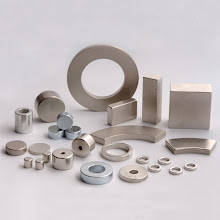
Chapter 3 of the pure praseodymium oxide ceramic microstructure and electrical properties were systematically studied. When the sintering temperature of 600 ℃, began to appear non-linear electrical properties, sintering temperature above 1000 ℃, the relative density of praseodymium oxide ceramics have significantly improved. AC impedance analysis shows that there exist in the grain boundary layer of the grain boundary impedance. Given there is no segregation in the grain boundary phase, proposed the origin of the grain boundary resistivity layer in the grain boundary barrier. Different temperatures measured by the volt-ampere characteristic curve demonstrated that the presence of double Schottky barrier, and calculate the grain boundary barrier parameters. Praseodymium http://www.everbeenmagnet.com/en/products/110-sintered-neodymium-magnets oxide with OSC (oxygen storage) features, the release of oxygen in the heating process, the absorption of oxygen in the cooling process. We believe that the grain boundary potential built up from the cooling process of oxygen adsorption, and this view was supported by AES depth analysis. According to Gupta and Carlson made the ZnO varistor defect barrier model, proposed amendments to the defect barrier model to explain the praseodymium oxide grain boundary barrier formation in the depletion layer exists in the VO * and VO **. Two types of donor defects. And ZnO with different excess interstitial zinc ion is praseodymium oxide-based oxygen vacancies is n-type semiconductor, the praseodymium oxide varistors have excellent electrical stability and resistance to aging.
Chapter 4 and the alternative use of liquid-phase sintering of praseodymium oxide reaction method for the densification of ceramics. Bi203 in the liquid phase sintering process to form a grain boundary segregation in the region to promote the sintering of ceramics, CuO and ZnO can substitute for praseodymium oxide, praseodymium ions in the crystal lattice, resulting in defects in the sintering process for volume diffusion and grain boundary diffusion , thereby increasing the praseodymium oxide ceramics density. Proposed addition to the ionic radius, bond type is also an important factor affecting substitution reaction.
Chapter 5 of the terbium oxide ceramics and non-linear electrical behavior of conductive mechanism were studied. Terbium oxide varistor with low varistor voltage, while showing excellent dielectric properties, and energy absorption capability, can be applied to microelectronic circuit overvoltage protection. Deal with different atmosphere terbium oxide ceramic grain boundary barrier parameters, we believe that terbium oxide and praseodymium oxide varistor varistor, as is also the origin of the nonlinear absorption of oxygen in the grain boundary.
Chapter 6 Tb system were prepared ZnO varistor and ZnO-Pr6O11 composite varistors. Like with Pr6O11, Tb4O7 for the generation of nonlinear ZnO varistor has a crucial role. Praseodymium oxide and terbium oxide according to the commonality, we believe the ZnO varistor Tb system should Tb4O7 nonlinear characteristics of the oxygen storage, the need for further research. Preparation of ZnO-Pr6O11 composite varistor has a range of 1.5 to 26.9 in non-linear coefficient and the range of 26 ~ 829V/mm varistor voltage, so you can change the composition of composite ceramics obtained the pressure to meet the actual needs of different thermistor. In addition, the linear resistance of rare earth oxides are given the experimental data.Degree Year: 2009


0 条评论:
发表评论
订阅 博文评论 [Atom]
<< 主页